Neo Sindarin - Copula
The problems with the copular system
The copular system may sound simple, but it introduces three chief problems that leave Sindarin writers scrambling and divide opinion:
- There's no distinction between tenses
- There's no distinction between predication and attribution
- There's no distinction between predication of nouns and genitive constructions
Past and future tense copula
Paul Strack from Eldamo have tried to address this issue, which he explains on his page about the copula.
The issue can be illustrated with the following three sentences:
  Elrond is there
  Elrond was there
  Elrond will be there
Translating that to Sindarin with a zero copula yield the exact same translation to all three sentences:
Elrond ennas
How can that be disambiguated? Paul analysed the na- verb and figured that Tolkien actually left clues as to what that would look like in the past tense and future tense. With some educated guesses, he suggested the use of a past tense copula nî and a future tense copula tho, which would yield the following translations:
  Elrond ennas     = "Elrond is there"
  Elrond nî ennas  = "Elrond was there"
  Elrond tho ennas = "Elrond will be there"
Some say that tho doesn't fit with the later etymology of the future suffix, so the alternative would be to use natho instead:
Elrond natho ennas = "Elrond will be there"
Predication and attribution
A predication is basically a meaningful declarative sentence that is true or false. For example:
the elf is tall
An attribution refers to a word or word group, such as an adjective, that is placed adjacent to the noun it modifies without a linking verb. For example:
the tall elf
A predicative sentence in Sindarin requires the use of a zero copula. The issue is that the translation for both sentences is identical:
  en·edhel dond = "the elf is tall"
  en·edhel dond = "the tall elf"
The solution that Sindarin writers came up with is to not mutate an adjective if it's being used in a predicative sentence:
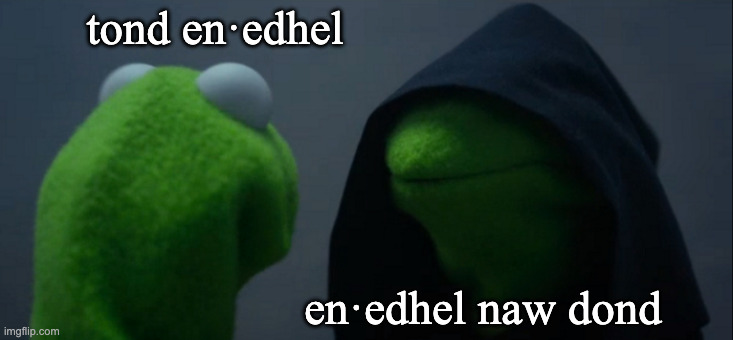
  en·edhel tond = "the elf is tall" → unmutated, predicative
  en·edhel dond = "the tall elf"    → mutated, attributive
However, some people think this is not a good solution because there is no evidence that Tolkien had ever used such a mechanic.
An alternative solution is to reverse the order of the predicate:
  tond en·edhel = "the elf is tall" = "tall [is] the elf" (lit.)
  en·edhel dond = "the tall elf"    = "the elf tall" (lit.)
Copula vs genitive
A genitive is a construction for expressing relations between two nouns. See the section below for more information.
In Sindarin, as explained below, a genitive is formed by positioning two nouns of a chain in sequence, next to each other, like so:
aran Moria = "[the] king [of] Moria"
The problem is that nouns can be used in predicative sentences, as much as adjectives do. The difference is that nouns don't mutate like adjectives when using zero copula, so the syntax for a zero copula with two nouns is identical to a genitive construction:
  rhovan callon = "[a] beast [is] [a] hero" → copula
  rhovan callon = "[a] beast [of] [a] hero" → genitive
Fiona Jallings, author of A Fan's Guide to Neo-Sindarin, tried to tackle this problem by suggesting we use soft mutation for predicative sentences using the copula, using the opposite mechanic used with adjectives. This way it would be easy to disambiguate:
  rhovan gallon = "[a] beast [is] [a] hero"
  rhovan callon = "[a] beast [of] [a] hero"
The problem with this approach, again, is that it's not attested anywhere. It's an invention. Another problem is that this doesn't work with nouns that start with vowels, as vowels don't mutate.
One possible solution is to use the definite article on the first noun to force a copula:
e·throvan callon = "the beast [is] [a] hero"
That occurs because the genitive only allows the article on the last noun.
To express "a beast is a hero", keeping it undefined and disambiguated, some suggest using a word for "one", or "some". These words act like adjectives, however. Example:
  rhovan nodui callon = "beast some [is] [a] hero"
  rhovan er callon    = "beast one [is] [a] hero"
There is no straight-forward solution to this problem.
Suggestions
To help disambiguate all the cases presented above, I suppose there are 3 best practices one should keep in mind:
a) use tense copulas
Paul Strack's solution for disambiguating the past, present and future tense copulas seems reasonable, and I think it should be used.
b) reverse adjectival predicates
Always reverse the adjectives in a predicative sentence to prevent making it attributive.
c) use the definite article to disambiguate from genitives
In a genitive chain, the article can only be used in the last noun of the chain, and it changes the definiteness of the whole chain. If one uses the article in the first noun of the chain, it has to be interpreted as a predicative sentence:
  e·throvan callon = "the beast [is] [a] hero"   → copula
  rhovan e·gallon  = "[the] beast [of] the hero" → genitive
The frowned upon path
David Salo has developed a whole system for Neo-Sindarin back in the 1990s. Some of Salo's interpretations — especially where he "filled gaps" in vocabulary or grammar - are viewed today as inventions rather than canonical Tolkien material. Many aficionados and scholars have moved toward more conservative reconstructions, sometimes preferring more strictly text-based (i.e. Tolkien's own writings) approaches over Salo's expansions. His contributions to Neo-Sindarin were published in 2004 in his book A Gateway to Sindarin, and ever since, there has been at least 8 new editions of Parma Eldalamberon, containing a substantial amount of notes by Tolkien that revealed previously unknown details about Sindarin and rendering Salo's work outdated.
All that said, David Salo is a competent linguist, and his contributions to the phonetic development of Sindarin and verb system reconstruction were very valuable. One of the gaps in Sindarin that Salo felt like filling was a reconstruction of the "to be" verb, na-. Which, by the way, he used moderately in his translations for the Peter Jackson film adaptations.
His "to be" reconstruction is extremely hypothetical, but it looks like this:
  na- ("to be")

  Infinitive ..............: naw     - be (OS nōbe)
  Gerund ..................: nad     - being
  Imperative ..............: naw, no - be
  Present participle ......: naul    - being
  Past passive participle .: naun    - been
  Perfect active participle: nóniel  - having been

  Present tense

  1st person - naun  - I am
  2nd person - ?     - thou art
  2nd person - ?     - thou art
  2nd person - ?     - thou art
  3rd person - naw   - he/she/it is

  1st person - nam   - we are
  2nd person - ?     - you are
  3rd person - nar   - they are

  Past tense:

  1st person - nónen - I was
  2nd person - ?     - thou wast
  2nd person - ?     - thou wast
  2nd person - ?     - thou wast
  3rd person - naun  - he/she/it was (non)

  1st person - nónem - we were
  2nd person - ?     - you were
  3rd person - nóner - they were

  Future tense:

  1st person - nathon - I will be
  2nd person - ?      - thou wilt be
  2nd person - ?      - thou wilt be
  2nd person - ?      - thou wilt be
  3rd person - natha  - he/she/it will be

  1st person - natham - we will be
  2nd person - ?      - you will be
  3rd person - nathar - they will be
As mentioned above, most enthusiasts have moved toward more conservative approaches, which means that Salo's paradigm is not widely used, and sometimes strongly opposed by most Neo-Sindarin users. It is also probably not compatible with Paul Strack's copulas, and since it has tiny evidence from any known Tolkien writings, it's considered an invention. However, it's undeniable that it fixes all problems with predication and attribution:
  Elrond ennas       = "Elrond is there"
  Elrond naun ennas  = "Elrond was there"
  Elrond natha ennas = "Elrond will be there"

  en·edhel naw dond  = "the elf is tall"
  en·edhel dond      = "the tall elf"

  rhovan naw gallon = "[a] beast is [a] hero"   → Salo's 'to be'
  rhovan callon     = "[a] beast [of] [a] hero" → genitive
There is a whole discussion on whether this kind of paradigm should be used. One argument for its use is that Tolkien didn't write many texts in Sindarin in the first place, and it's easy to imagine that, at some point, were he able to work on this project further, he would need to create a "to be" paradigm sooner or later. The copula doesn't work all that well and it's counter-intuitive. One argument against its use is that a language is only useful when people understand what's being communicated. If one uses a paradigm not widely recognised, it's doomed to be an outlier. Many Neo-Sindarin writers try to preserve as much of Tolkien's original ideas for Sindarin, and unfortunately a "to be" paradigm has not been much documented to justify its use, so many people reject it. I think it depends on your audience. The Sindarin in the films seem to have worked, so although I don't use it much, I favour its adoption. This guide, however, will stick to the zero copula and ignore Salo's "to be" paradigm from this point onwards, so we can focus on the same flavour of Neo-Sindarin that is preferred by the majority of the community.